


There is a saying in the currency circle that "If you don't want to become a leek, don't touch contracts (futures)." I feel that this sentence has been deeply imprinted in everyone's hearts since then. There is a stereotype that contracts are terrible demons, but in fact, you have to think about it. Sometimes it’s not necessarily a problem with the product itself. Sometimes it’s just that investors don’t understand the features of the product enough, which stigmatizes the so-called “perpetual contracts” (or virtual currency futures).).
Cryptocurrency futures, what is a perpetual contract? This article hopes to let everyone know more about this product through the teaching of perpetual contracts. In the future, novices will be able to pick up such a practical investment tool at their fingertips as they gradually become veterans.
ㄧ. Foreword: What is a perpetual contract? Virtual currency futures?
"Perpetual futures contract" is called a sustainable contract, also known as a perpetual contract(Perpetual Futures, PERP for short), is a futures contract with no expiration date, also known as cryptocurrency futures. Unlike traditional futures, which expire monthly, quarterly, or annually, perpetual contracts will remain open until you decide to close your position. This allows traders to hold positions as long as they want without having to worry about expiration and rollover fees.
What are cryptocurrency contracts?
The contracts on the exchange refer to futures contracts. Simply put, they are cryptocurrency futures, called Futures in English. They are actually similar to traditional financial index futures, individual stock futures, gold futures, etc., but there are some differences in the system. I want to confuse it with a smart contract (Smart Contract). One is a financial product and the other is a blockchain code. They are completely different things. When people talk about playing contracts, they are definitely futures contracts. , not a smart contract.
Cryptocurrency Contract Features
Generally, traditional financial futures are similar to cryptocurrency contracts. There is nothing special to introduce. There is only one biggest difference between the two, which is the expiration date! Traditional financial futures have an expiration date, and each month clearly stipulates which day will expire and be settled. However, most cryptocurrency contracts have no expiration date. Contracts above 95% are called perpetual contracts and never have an expiration date. , so there is no settlement, delivery, rollover, or forwarding, and only a few contracts are expiring contracts.
It seems convenient that the perpetual contract has no expiration date, but it has a fatal flaw, that is, there may be a large price difference between futures and spot prices that never converge. For example, the spot price of Bitcoin is 35,000, but the contract price has always been 32,000. Once this phenomenon occurs , which means that the contract price is distorted. A distorted price will reduce the interest of investors. Therefore, in order to solve this problem, the exchange uses the funding rate to converge the price difference between the two.
When the futures price of a currency is greater than the spot price, the funding rate will be positive, which means that those who are long will have to pay a funding fee to those who are short every once in a while. By charging those who are long an extra A fee reduces everyone's motivation to go long, and at the same time distributes this money to short sellers, increasing everyone's motivation to go short. In this way, as the long army becomes weaker and the air force becomes stronger, the contract price will fall. It stops when it falls to about the same as the spot price, achieving the goal of futures and spot price convergence. , this is the role of the funding rate. Similarly, if the spot price is greater than the contract price, the funding rate will be negative, and short sellers will have to pay fees to long sellers.
Suppose, you are observing a virtual currency called B currency, and its price in the spot market is $200. You think that the price of B coin will rise in the future, but you don't really want to hold B coin, so you choose to trade in perpetual contracts.
- Start trading: With $200, you enter into a perpetual contract, betting that the price of Coin B will rise. In this scenario, you don't actually hold Bcoin, but a contract that will earn or lose funds based on the price fluctuations of Bcoin.
- Features of perpetual contracts: Unlike futures contracts, perpetual contracts have no definite expiration or settlement date. This means you can choose to settle or close your position at any time.
- Price increased: Assume that after a few days, the price of Coin B rises to $220. Since your bet is that the price will go up, you have made $20 on this perpetual contract. At this point, you can choose to close your position and collect your profits.
- price drop: Conversely, if the price of Coin B falls to $180, then you will lose $20. You may choose to wait for the price to rise again, or you may choose to close your position at this price and accept a loss of $20.
- Impact of Funding Rate: During the period of holding the perpetual contract, you may need to pay some fees or receive some fees according to the funding rate. This will change according to the long-short allocation of the market and the relationship between the price of the perpetual contract and the spot price.
This example shows how a perpetual contract basically works and highlights one of its key differences from traditional futures contracts: it has no fixed expiration or settlement date. This provides greater flexibility, allowing traders to choose to settle or close their positions at any time.
Comparison of perpetual contracts and traditional futures
Compared with traditional futures, perpetual contracts have various advantages:
| Comparative category | traditional futures | Perpetual contracts |
|---|---|---|
| expiry date | With due date pressure | No expiration date for greater flexibility and control |
| cost | There is an extension fee | Low transaction costs, no rollover fees |
| lever | limited leverage | High leverage, up to 100 times |
| Tax incentives | Capital gains tax etc. may apply | May be taxed at lower rates (depending on jurisdiction) |
| speculation | attract speculators | Attracting Day Trading and Scalping Strategies |
| anonymous transaction | authentication required | Some platforms allow anonymous transactions |
Note that while perpetual contracts have these advantages, they also come with some risks and challenges, including possible loss amplification due to high leverage, and the possibility of illegal activities due to anonymous transactions. Before entering into any transaction, it should be deeply understood and carefully evaluated. Also, tax treatment varies by jurisdiction and you will need to check the tax laws in your location.
Risks of Perpetual Contract Trading
While perpetual contracts offer significant benefits, they also pose risks:
- high volatility: Due to market sentiment and liquidity, the price of a perpetual contract may fluctuate significantly in either direction. This makes them riskier than traditional futures.
- manipulate: The unregulated market and the high leverage of perpetual contracts allow large traders to manipulate prices. You could face reckoning for manipulating a whale-induced flash crash.
- hacker attack: There have been many hacking incidents on the perpetual contract platform, resulting in the loss of funds. Only trade with reputable platforms that have strong security and insurance funds to cover losses caused by hackers.
- addiction: The volatile, speculative and highly leveraged nature of perpetual trading can be addictive and lead to significant financial losses, especially for inexperienced traders. Practice disciplined risk management and know when to walk away.
2. What is a contract? The basic concepts of contracts are different from spot
As technology advances,cryptocurrencyIt has become a part that cannot be ignored in today's financial market. In the world of cryptocurrency, in addition to the most basic "buy low, sell high" strategy, there are also a variety of trading methods for investors to choose from. Today, let's dive into the main types of transactions. Among them, perpetual contracts, also known as perpetual swaps, are popular in the cryptocurrency market. Major exchanges like Binance, OKEx, and Huobi offer perpetual contracts on currencies like Bitcoin, Ethereum, and Litecoin. These never-expiring cryptocurrency futures have become a favorite tool of day traders and scalpers looking to take advantage of short-term price swings.
1. Spot Trading: Definition and Characteristics
Spot trading, in simple terms, is buying or selling realcryptocurrency. When you make a spot transaction, you actually hold ownership of the virtual currency, which will be stored in your digital wallet. This trading method is characterized by being intuitive and simple, suitable for beginners.
2. Futures Trading: Traditional Futures Contracts Explained
Futures trading is a kind of derivatives trading. When you buy or sell a futures contract, you are buying the right to buy or sell a cryptocurrency on a certain date in the future. That means, you don't really hold thoseVirtual currency, but holds a contract. This makes futures trading leveraged, which means you can make larger trades with relatively small capital, but it also increases risk.

3. Perpetual contract: why is it called "perpetual"?
Perpetual contract is a new star in the cryptocurrency market, which combines the characteristics of spot trading and futures trading. Unlike traditional futures contracts, perpetual contracts do not have a fixed expiration date. This means traders can hold a perpetual contract for as long as they wish without worrying about the contract expiring.
So why is it called "sustainable"? Mainly because such contracts utilize specific mechanisms, such as funding rates, to ensure that the contract price remains relatively close to the spot price at all times. This design makes perpetual contracts a very attractive trading tool, especially for traders who want to use leverage, but do not want to be limited by the contract expiration date.
4. Funding rate of the contract
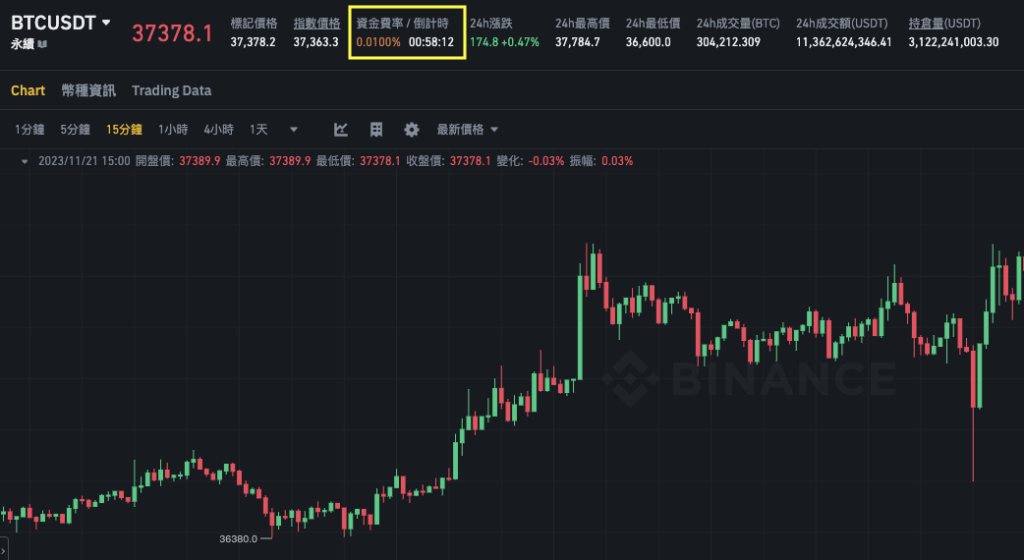
As long as there are exchanges that provide contracts, they will have funding rates, but the rates and collection times of each exchange are not necessarily the same. Most exchanges charge once every 8 hours. Unless there are special circumstances, they will charge at the basic value of 0.01%. In other words, if you are long a contract with a position of 10,000 US dollars, you will be charged 10,000 x 0.01% x 3 = 3 US dollars every day. If the funding rate remains unchanged for one year, you will be charged 1,095 US dollars. US dollars. So this thing may seem like a small amount at first glance, but in the long run, it’s actually a big sum. If you want to be a friend with a long-term contract, you must not forget the cost of capital.
5. The difference between spot and contract
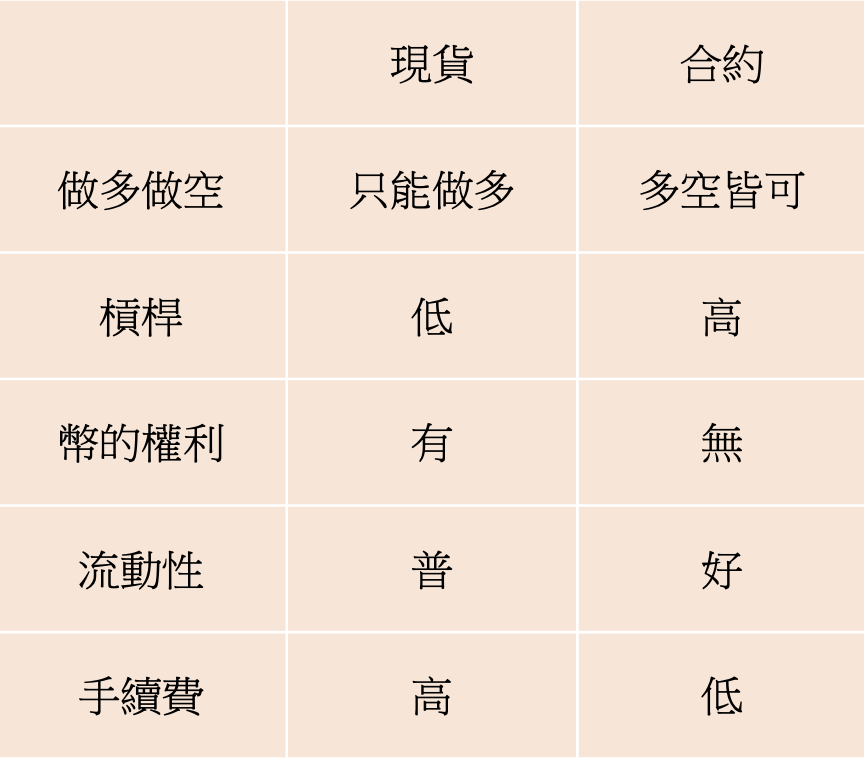
In fact, buying and selling spot is essentially the same as making a contract. They are both betting on the direction of a currency. As long as you do it right, you can earn the price difference in the middle. The only difference is in the tools used. Below, I will help you sort out the differences between spot and contract. Main differences.
Go long or short
Spot trading can only be one-way long and not short, while contracts can be long or short. If you only do spot trading, when you are short on the trend of a certain currency, there is nothing you can do. The most you can do is sell the currency in your hand early, and then watch it fall without making any money. And if you know how to make contracts, you can easily go short and earn the price difference of the decline.
open leverage
The big reason why so many people play contracts is that they can be opened with high leverage. Although it will vary depending on the currency and exchange, it is generally about 1-100 times. For people with small capital, this is a good opportunity. Assuming 10 times leverage is enabled, 100 US dollars can be used to go long to 1,000 US dollars. If the currency price rises by 20%, it will be a profit of 200 US dollars. The investment in 200% Rate of return, who doesn’t love this kind of number? But be careful, high leverage implies high risks and high rewards. Taking the example just now, if you go long with 10 times leverage, the currency price will be liquidated as long as the price drops by 10%, and the $100 will be returned to zero. Therefore, I would like to advise everyone, before opening any amount of leverage, please evaluate your own risk tolerance. Don't blindly pursue high returns and forget about high risks, otherwise you will lose money very quickly.
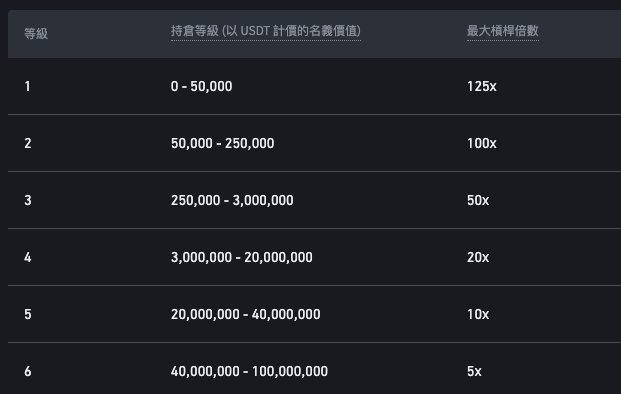
Binance BTC/USDT contract leverage ratio
In terms of spot, although exchanges also provide leveraged spot functions, which are similar to financing on stocks, due to the complexity of the operation, the leverage is not as large as that of contracts, and interest is calculated, so most people still choose contract operations, which is simpler and more convenient. In terms of risk, holding spot will never be liquidated. Although the reward is lower than opening leverage, the risk is relatively much smaller.
Coin ownership
When buying spot, the coins belong to you. These coins can be placed in the spot account, used as transaction payment, or placed in financial products on the exchange to earn extra profits. Players who can play with blockchain can also use these coins. There are many uses for transferring coins to the chain for storage, or participating in Defi projects on the chain.
The operating contract is different. The contract is essentially just a contract. It is just a money game. It is purely about earning the price difference between long and short. It is the same no matter what currency you are dealing with, such as BTC or ETH. You do not hold these currencies yourself. , only the gains and losses from ups and downs can be taken away.
fluidity
We all know that the trading volume of contracts is much larger than that of spot, which also means that the liquidity of contracts is better than that of spot. Whether it is the bid-ask spread or the supply of volume, contracts can provide better quotes to investors. However, this is limited to medium and large currencies. The liquidity of some unpopular currency contracts is not very good, but compared with spot, it is still better.
handling fee
The spot handling fees of most exchanges are usually higher than those of contracts. The following figure lists the five exchanges commonly used by Taiwanese. You can see that the handling fees of maker orders are 4-5 times higher than those of contracts.
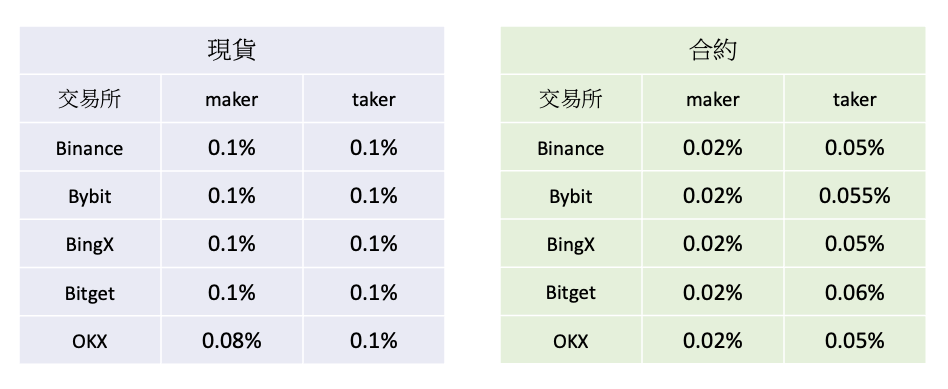
Comprehensive comparison
3. What is a perpetual contract? Cryptocurrency futures? The operating mechanism and use of perpetual contracts
Perpetual contracts, also known as perpetual futures or continuous futures, are futures contracts that have no expiration date. Unlike traditional futures, which expire on a specific date, perpetual contracts roll over day after day, allowing traders to hold funds as needed. In addition to being able to flexibly use your own funds to go long or short on future values, another most important function is that you can do leveraged trading. Matching your own risk attributes can amplify your returns (but the risk will also increase)
1. How does the perpetual contract work?
Perpetual contracts work similarly to traditional futures contracts, but have no expiration date. They are traded on exchanges, allowing traders to speculate on the price of the underlying asset. The main difference is that a position in a perpetual contract can remain open indefinitely because the contract rolls over every day.
As shown below: Traditional spot trading means that you use 1000U to buy 1000U worth of Bitcoin.

But the concept of a leveraged contract is that you use (ten times leverage) 100U to buy a trading certificate worth 1000U (you do not actually hold the spot)

2. Why does the perpetual contract have no expiration date?
Perpetual contractsThere is no expiration date, so traders have the flexibility to hold positions for as long as they wish. This allows for longer term speculation and hedging. If there is no expiration date, traders don't have to worry about closing positions or rolling contracts into the next month. Perpetual contracts are similar in nature to spot markets, but with the leverage that comes with futures.
3. Leverage trading in perpetual contracts
Perpetual Contracts are a very popular financial derivative in cryptocurrency trading, which allow traders to use leverage. Leverage allows traders to make large trades with relatively small amounts of money, meaning potential gains and losses are magnified.
For example, if you use 10x leverage, you only need to invest $100 to make a transaction equivalent to $1,000. If the market price rises by 10%, your return will be $100 (excluding transaction fees or other costs), which is the 100% of your original investment. But conversely, if the market price drops by 10%, you will lose your entire investment.


以上截圖截自:https://www.youtube.com/watch?v=CABoamnv6hc&ab_channel=Anue%E9%89%85%E4%BA%A8
4. How does the funding rate keep prices consistent with spot prices?
When we talk about the financing rate of the perpetual contract, we are actually talking about a mechanism that can keep the price of the perpetual contract relatively consistent with the spot price. To make it understandable to newcomers, I will use a simple explanation. (If you are really not interested, you can skip this part, and you can directly understand how to use it)
- How funding rates work: In the perpetual contract market, if the contract price is higher than the spot price, the long-term holder (buyer) needs to pay a small interest to the short-term holder (seller). Conversely, if the contract price is lower than the spot price, short-term holders pay interest to long-term holders.
- Funding rate adjustments: This rate is usually adjusted every 8 hours. When the contract price deviates farther from the spot price, the interest rate will increase accordingly.
- The impact of the funding rate on the market: When traders need to pay a high interest rate (fee rate), they may reconsider their position strategy. For example, if a long-term holder finds out that he is paying a large amount of interest to a short-term holder, he may choose to liquidate or reduce his long position, which will bring the contract price down. Likewise, if short-term holders are paying large amounts of interest, they may add to or open long positions, causing the price to rise.
In this way, the funding rate incentivizes traders to keep the price of the perpetual contract in line with the spot price.
5. How to use funding rate to judge the market?
The funding rate (or financing rate) of the perpetual contract is a mechanism to ensure that the price of the perpetual contract remains close to the spot price. The positive and negative value of the funding rate is related to the distribution of long and short positions in the market.
Here is a simple explanation of when a positive or negative funding rate occurs and how long-short allocations affect it:
- Positive funding rate:When the price of the perpetual contract is higher than the spot price,This means that the longs (buyers) in the market are more aggressive than the shorts (sellers). At this time, the long side needs to pay the funding rate to the short side as an incentive to encourage the short side to continue trading and maintain market equilibrium. Therefore, when bulls dominate the market, funding rates will be positive.
- Negative Funding Rate:On the contrary, when the price of the perpetual contract is lower than the spot price,It means that there are more shorts in the market, or that shorts are more active than longs.. At this time, in order to encourage bulls to enter the market and maintain market equilibrium, shorts will pay funding rates to longs. Therefore, when shorts dominate the market, funding rates will be negative.
The positive or negative of the funding rate is not determined by the exchange, but by the supply and demand in the market. When there are too many long positions in the market, the price may rise more than the spot price, and the funding rate will be positive at this time. Conversely, when there are too many short positions in the market, the price may be lower than the spot price, and the funding rate will be negative at this time.
In short, the financing rate is a core mechanism of the perpetual contract market, which ensures that the price of the perpetual contract is relatively consistent with the price of the spot market through economic incentives. For newbies, understanding this is critical to making informed trading decisions.
4. How do beginners start trading perpetual contracts?
You should be tempted to give this cryptocurrency trading strategy a try. While the strategy is risky, the potentially high-return instrument can be appealing, so make sure you understand the product accurately before you begin. Below I will talk about how beginners should step into this field (but I actually don’t recommend beginners to play this, because the risk is still too high, unless you are confident that you have done enough homework)
1. Choose the right exchange
The major exchanges offering perpetual contracts are BitMEX, OKEx, Binance, Huobi, and Deribit. Each scheme has its pros and cons in terms of leverage amount, liquidity, fees and currencies offered. Do your research to determine which exchange is best for your needs. The most popular and liquid contracts tend to be major cryptocurrencies like Bitcoin, Ethereum and Litecoin.
2. Formulate trading strategies for perpetual contracts
With perpetual contracts, you need to actively monitor and manage your funds. Here are some tips for profitable trading of perpetual contracts:
- use leverage sparingly: While high leverage means bigger gains, it can also mean bigger losses if the market moves against you. Start with lower leverage, say 5-10x, until you get the hang of it.
- Set a stop loss order: If the price starts to drop, place a stop loss order to limit your losses. As the price rises, raise your stop loss to lock in profits.
- long and short: Whether the market is rising or falling, you can use perpetual contracts to make money. Look for reversal signals to determine when to switch positions.
- extend and expand: Instead of getting in and out of money all at once, build up by buying a lot when the price is down, or by selling a lot when the price is up. This helps to achieve a better average entry or exit price.
- Follow trends and technical analysis: View moving averages, support and resistance levels, and other indicators to help determine entry and exit points. Go with the flow for your best chance of success.
3. Start small
When you're ready to trade perpetual contracts, start small while learning. Only risk what you can afford to lose as these highly leveraged products can result in significant losses. But perpetual futures contracts also have the potential to deliver big gains if traded correctly. With the right strategy and risk management, perpetual contracts can be a useful tool for active cryptocurrency traders.
4. Recommended contract trading strategy: Contract Grid
What is Contract Grid?
Contract grid is a contract automated trading strategy that buys low and sells high in a specific price range to earn fluctuating profits. Users only need to set the highest price and lowest price in the range, determine the number of grids to be subdivided, and then start running the strategy. The strategy will calculate the price of buying low and selling high in each small grid, and automatically place orders. As the market fluctuates, it will continue to buy low and sell high or sell high and buy low to earn profits from fluctuations.
What are the benefits of contract grid?
- Reduce difficulty: Compared with single-point transactions in general contract transactions, contracts can be replaced by intervals, reducing the pressure of opening orders.
- Leverage arbitrage: Maximize the benefits of volatile market conditions (compared with the general grid, it can increase the efficiency of profit-making), and use the fluctuations in the currency circle to accelerate arbitrage
- spread risk: Running on a grid can disperse the points to enter the market.


Sincere Promotion: Want to try Contract Grid right away?
Let’s make profits together and earn high annualized returns. You are welcome to use my Paiwang invitation code:mPsxdkaI, or registration link:https://www.pionex.com/zh-TW/sign/ref/mPsxdkaI

Conclusion: The place of perpetual contracts in cryptocurrency trading
Perpetual contracts, also known as perpetual swaps or perpetual futures, are an innovative new product in cryptocurrency trading that offer traders greater flexibility. Unlike traditional futures contracts that expire, perpetual contracts have no expiration date and remain open until you decide to close your position. This allows traders to hold funds for as long as they want without having to worry about expiration and rollover fees.
Possible risks and limitations of perpetual contracts
While perpetual contracts offer some attractive benefits, they also pose risks that traders should be aware of before committing to them.
Some key risks and limitations include:
| Risk project | describe |
|---|---|
| high leverage | Perpetual contracts provide up to 100 times leverage, which can control large positions with less funds, but may lead to rapid accumulation of losses. |
| liquidation risk | Under high leverage, if the margin is lower than the maintenance margin level, there is a risk of forced liquidation, and the position may be liquidated to avoid further losses. |
| price slippage | When the volatility is high, the execution price of the order may be different from the expected one, and the high leverage and volatility of the perpetual contract increase the risk of price slippage. |
| Funding costs | Perpetual contracts charge regular funding fees to keep the contract price in line with the underlying spot market price, which can be costly for long-term positions. |
| volatility | Perpetual contracts are generally more volatile than traditional markets, and this combined with high leverage can lead to wild swings in position values and margin levels. |
All in all, while perpetual contracts offer an innovative way to trade the cryptocurrency market, they also introduce additional risks that traders must fully understand. Due to their high leverage and volatility, perpetual contracts may not be suitable for all trading styles or experience levels. However, for traders who can actively manage risk, perpetual contracts offer the opportunity to earn high returns. Perpetual contracts quickly became popular and now account for a significant portion of total cryptocurrency trading volume.
Q&A: What is a perpetual contract?
Q: What is a perpetual contract? Cryptocurrency futures?
A: A perpetual contract is a financial derivative, similar to a traditional futures contract, but without an expiration date. Traders can hold these contracts indefinitely without worrying about expiration pressure.
Q: What is the difference between perpetual contracts and traditional futures?
Answer: The main difference between perpetual contracts and traditional futures is the expiration date. Perpetual contracts have no expiration date, whereas traditional futures expire on a specific date. Additionally, perpetual contracts typically offer higher leverage and may have higher volatility.
Q: What are the advantages of perpetual contracts?
Answer: The advantages of perpetual contracts include: no expiration date pressure, low transaction costs (no rollover fees), high leverage, possible tax incentives, suitable for speculative transactions, and some platforms allow anonymous transactions.
Q: Is high leverage an advantage or a risk of perpetual contracts?
Answer: High leverage is both an advantage and a risk of perpetual contracts. High leverage enables traders to control large positions with a small amount of capital, thereby achieving greater profits. However, high leverage also means the potential for quick losses, making risk management critical.
Q: What is liquidation risk?
Answer: Liquidation risk means that in leveraged trading, if the margin level is lower than the maintenance margin requirement, the exchange may liquidate the trader's position to avoid further losses. This is because with high leverage, losses can accumulate quickly, resulting in insufficient margin.
Q: What is the funding fee for the perpetual contract?
Answer: The perpetual contract charges a funding fee periodically to ensure that the contract price is consistent with the underlying spot market price. Traders pay or receive funding fees based on the positions they hold, which can result in additional costs for long-term positions.
Q: Which traders are perpetual contracts suitable for?
Answer: Perpetual contracts are suitable for traders with extensive trading experience and familiarity with risk management, especially those who want to conduct speculative transactions, take advantage of high volatility, or use day trading and scalping strategies. Beginners should be cautious about the high leverage and risks of perpetual contracts.