


This article will lead you to explore the mystery of Defi (decentralized finance). You will learn about the five characteristics of Defi, its changing role in the financial field, and how to start an open financial revolution. More importantly, we will explore how Defi can solve various problems of the traditional financial system.
In recent years, decentralized finance (Defi) has attracted much attention and has gradually become an emerging field in the financial world. So, what is DeFi? Simply put, Defi is a financial service and product realized through blockchain technology and smart contracts. These services and products aim to remove middlemen in the traditional financial system, making financial transactions more transparent, secure and efficient.
In the traditional financial system, we rely on banks, insurance companies, and other financial institutions for various financial activities, such as loans, payments, and wealth management. However, these traditional institutions often operate through cumbersome procedures and intermediaries, making transactions slow, expensive and of limited credibility.
This is where the advantage of Defi lies. It directly connects transaction participants through a blockchain-based decentralized platform, and uses smart contracts to ensure transaction execution. This direct transaction mode eliminates the intermediate links in the traditional financial system, thus providing lower transaction costs, faster transaction speed and higher transaction security.
1. What is Defi (Decentralized Finance)?
Defi is not just a technological innovation, it also redefines our view of finance. In Defi, anyone has the opportunity to participate in the financial market, no longer limited to a specific geographical area or identity. This open and decentralized nature provides individuals with greater financial freedom and autonomy.
In addition, Defi also promotes financial innovation and cooperation. Through the open source smart contract platform, anyone can create and publish new financial products and services, and attract others to participate. This spirit of openness and cooperation has injected new vitality and creativity into the development of the financial field.
In general, Defi (Decentralized Finance) not only brings us more efficient, cheaper and safer financial services, but also redefines the traditional financial landscape, allowing everyone to freely participate in the financial market and innovation. In the following content, we will explore various aspects of DeFi in more depth in order to better understand and take advantage of the opportunities and challenges brought about by this financial revolution.
2. What are the five main characteristics of Defi?
Defi (Decentralized Finance) is an important concept that has emerged in the financial field in recent years. Based on blockchain technology, it redefines the traditional financial landscape by utilizing smart contracts and decentralization. Defi has unique five main characteristics, which make it attract huge attention and importance in the financial industry. The following are the five main characteristics of Defi:
- decentralized: The core idea of Defi is decentralization. Traditional financial systems are usually controlled and managed by a central institution, while Defi is based on blockchain technology, which delegates the control of financial activities to smart contracts and decentralized applications. This means that Defi does not need to rely on traditional financial institutions, making financial services more secure, transparent and open.
- Distrust: Defi executes financial transactions through smart contracts, eliminating the need for middlemen and reliance on trust. A smart contract is a programmed automatic transaction agreement, which ensures that the execution of the transaction is not subject to human interference or tampering, thereby ensuring the fairness and reliability of the transaction. This trustless feature makes financial activities more efficient and sustainable.
- interoperability: Various applications and platforms in the Defi ecosystem can connect and collaborate with each other to achieve a higher degree of interoperability. This allows financial services to flow more freely between different applications, thereby providing users with more diversified and convenient financial services.
- transparency: Blockchain technology endows Defi with higher transparency. All transactions and records of smart contracts are recorded on the blockchain and can be publicly inspected. This enables Defi users and participants to better monitor and verify the execution and results of transactions, reducing unnecessary risks and potential fraud.
- openness: Defi is an open financial system in which anyone can freely participate. Compared with the traditional financial system, Defi is not restricted by geographical location, identity authentication or wealth class. Anyone who has the Internet and a blockchain wallet can participate in Defi's financial activities. This openness creates a more equitable and inclusive financial environment.
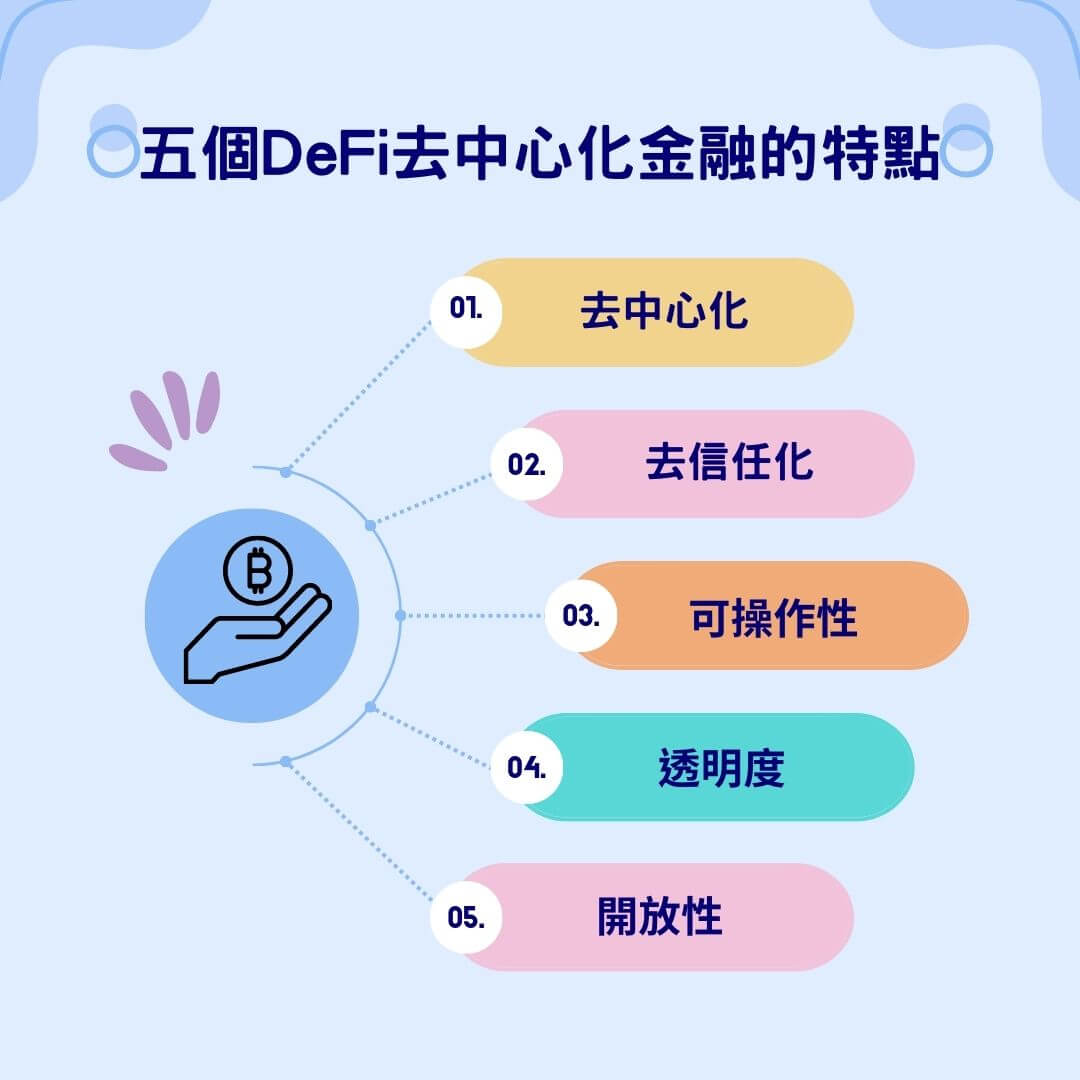
These are the five main characteristics of Defi, which together bring a revolution to the traditional financial industry. The importance of DeFi is not only reflected in the improvement of the efficiency and security of financial services, but more importantly, it provides opportunities for more people to participate in financial activities and promotes the decentralization and democratization of finance. In the future, Defi will continue to play an important role in the financial industry, bringing us more innovations and opportunities.
3. The changes and roles of Defi in the financial industry
The full name of Defi is Decentralized Finance. The emergence of decentralized finance is changing the role of the traditional financial industry. Here are a few ways how Defi is changing its role in the financial industry:
| difference comparison | traditional finance | Decentralized Finance (DeFi) |
|---|---|---|
| middleman role | Banks, securities companies and other intermediary institutions handle transaction processing, supervision, settlement and other links, and charge handling fees | Eliminate the role of the middleman and conduct financial transactions directly on the blockchain through smart contracts |
| transaction cost | High processing fees and intermediary agency fees | Since the participation of the traditional financial system is not required, low-cost transactions are realized through smart contracts and self-executing rules |
| Financial Services | May face higher thresholds and risks | More financial services are provided through smart contracts, such as decentralized lending and deposits, allowing users to participate in the financial market more conveniently |
| financial system stability | Financial crises and market risks often stem from mistakes or misconduct by institutions and intermediaries | The established blockchain financial system is decentralized, transparent and autonomous. The execution of smart contracts and the regulatory capabilities of the blockchain greatly reduce the risk of fraud and improper behavior, providing a more stable and reliable financial system |
These aspects of how Defi is changing its role in the financial industry present important challenges and opportunities for the traditional financial system. Whether it is reducing costs, providing more financial services, or improving the stability of the financial system, Defi is redefining the traditional financial landscape and playing a more important role. Regarding other impacts of Defi in the financial industry, we will further explore in the following paragraphs.
4. How does Defi create openness in the financial industry?
In the traditional financial system, many financial activities are managed and monitored by central institutions. This brings up a key problem - the central authority has monopoly power, which means that individuals' financial information and transaction records will be collected, controlled and utilized by the central authority. Such structures limit people's economic freedom and privacy.
The decentralized nature of Defi provides an open alternative. Through blockchain technology, people can carry out financial activities in a decentralized environment, completely independent of the control and intervention of central institutions. This openness brings several significant advantages:
1. No permission required: Defi protocols and platforms operate on the basis of blockchain technology, and anyone can participate without approval or permission from a central authority. This means that people are free to create and use financial instruments regardless of their identity, geographic location or wealth status.
2. transparency: In the Defi world, all transactions and contracts are open and verifiable. This transparency makes it possible for anyone to check at any time whether the activity complies with the rules and standards. This helps reduce fraud and misconduct while increasing trust in the financial system.

3. Interoperability: The Defi ecosystem consists of many different protocols and platforms, which can cooperate and integrate with each other. This interoperability means that people can freely convert and use assets between different Defi platforms, enabling more applications and greater liquidity.
4. innovative: Due to the openness of Defi, anyone can participate in innovation and develop new financial products and services. This innovation has brought more choices and competition, and made the entire financial system more active and healthy.
These characteristics of Defi make it an important force to redefine the traditional financial landscape. It not only eliminates the centralized control in the traditional financial system, but also provides more privacy, freedom and innovation opportunities. This has far-reaching implications for individuals and the entire financial system, and deserves our attention and deeper understanding.
Please note: In the next paragraphs, we will continue to explore other changing roles of Defi in the financial industry.
5. What is Defi (Decentralized Finance)? The technological revolution of financial remittance
One of the revolutions of Defi (decentralized finance) is in the field of remittances and cross-border payments. In the traditional financial system, sending money is usually a relatively slow and expensive process. It involves a cumbersome network of multiple financial intermediaries and international banks.
However, the emergence of Defi has changed all this. The decentralized financial platform utilizes blockchain technology and smart contracts to enable users to transfer money instantly across the globe, while reducing the involvement of intermediaries. This technological revolution not only provides faster and cheaper ways to send money, but also increases the transparency of financial transactions.
| difference comparison | traditional finance | Decentralized Finance (DeFi) |
|---|---|---|
| transaction speed | International money transfers can take days or longer to complete | Money transfers are usually completed within minutes |
| transaction cost | Remittances require high fees and exchange rate differences | Significantly reduce transaction costs by removing intermediaries and using smart contracts to automatically execute transactions |
| Transaction Transparency and Security | The remittance process is often opaque and difficult to trace | All transactions are publicly recorded on the blockchain, providing a high degree of transparency and verifiability, reducing the risk of fraud and fund laundering |
| Influence | High transaction costs and time can limit the development of global commerce | Provides a faster, cheaper and more transparent way to send money, promoting the development of global commerce |
6. How does Defi solve the problems of the traditional financial system?
There are many problems in the traditional financial system, such as centralization, inefficiency and high costs. However, the emergence of DeFi provides solutions to these problems and redefines the traditional financial landscape.
1. Decentralization
The core principle of Defi is decentralization, that is, direct financial transactions and operations without an intermediary. This feature makes Defi immune to the risk of failure or manipulation by a single institution, making the entire financial system more stable.
2. Reduce transaction costs
Whether in the traditional financial system or in Defi, transactions require payment of certain fees. However, in the traditional financial system, these fees often include intermediary agency fees, transfer fees, etc., which increase transaction costs. In Defi, due to the removal of intermediaries, transaction costs can be greatly reduced, enabling more people to participate in financial activities.
3. Improving the efficiency of financial services
Defi utilizes smart contracts and blockchain technology to realize automated and uninterrupted financial services. This means that financial transactions and operations can be carried out 24/7, without cumbersome intermediaries and delays. At the same time, due to the transparency of the transaction process, trust issues and disputes between parties are also reduced, and the efficiency of financial services is improved.
4. Promoting financial inclusion
In the traditional financial system, many people cannot obtain financial services for various reasons, such as lack of credit history, lack of collateral, and so on. However, in Defi, due to the characteristics of decentralization, anyone who has an Internet device can participate in financial activities without the need for intermediary review and restrictions, which promotes financial inclusion.
All in all, Defi, with its characteristics of decentralization, low cost, high efficiency and inclusiveness, not only redefines the traditional financial landscape, but also solves a series of problems existing in the traditional financial system. With the development and popularity of DeFi, it is believed that it will play a more important role in the future financial field.
You can refer to what is Defi (decentralized finance)?
Conclusion: What is Defi (decentralized finance)?
Through this article, we understand the importance of Defi (decentralized finance) redefining the traditional financial landscape and its impact. In the world of DeFi, the role of the financial industry has been changed and has the ability to create a more open financial environment. Defi not only solves some problems in the traditional financial system, but also promotes the remittance revolution, making cross-border remittance more convenient and affordable.
The five main features of DeFi, including decentralization, openness, transparency, interoperability, and security, make DeFi an important part of the future financial system. This emerging financial model provides more people with opportunities for financial services, and at the same time provides investors with more choices and benefits.
Judging from the popularity of DeFi, it is changing the way the traditional financial industry operates, not only bringing the entire industry to greater openness, but also encouraging financial institutions to better adapt and integrate this emerging technology.
Although Defi is still in its early stages of development and still faces some challenges, such as security and regulatory issues, its potential is undeniable. This emerging financial model has not only changed the role and operation of the financial industry, but also brought us more convenience and choices.
Therefore, it is critical to understand the importance of Defi (decentralized finance). It will continue to shape our financial landscape and bring us more opportunity and innovation. Whether it is a financial professional or an ordinary investor, we should maintain an attitude of further understanding of Defi and look for ways to participate in this emerging field.
Let us expand the possibilities of Defi together and witness the revolutionary changes it has brought to our financial world.
FAQ QA: What is Defi (Decentralized Finance)?
Question 1: What does Defi mean?
Answer: Defi, also known as decentralized finance, is a financial system that uses blockchain technology and smart contracts. Its goal is to cut out the middlemen in the traditional financial system and achieve decentralization and openness of financial activities. Through Defi, people can carry out financial activities such as lending, trading, and remittance through smart contracts without relying on traditional banks or financial institutions.
Question 2: What are the application areas of Defi?
Answer: Defi has a wide range of applications in the financial field, including lending, savings, trading, asset management, and insurance. These application areas utilize smart contracts andblockchain technologyGreater security, transparency and efficiency are achieved. For example, the Defi platform in the lending field can provide borrowing and borrowing matching services, and ensure the execution of lending transactions through smart contracts.
Question 3: What are the advantages of Defi?
Answer: Defi has many advantages compared to the traditional financial system. First of all, the decentralized structure of Defi makes financial transactions more transparent and secure, reducing the risk of middlemen. Secondly, the openness of Defi means that anyone can participate without restrictions on geography, identity, etc. In addition, Defi's smart contract technology can realize automatically executed and programmed financial agreements, improving efficiency and reducing human errors.
Question 4: How safe is DeFi?
Answer: Although DeFi applications are built on highly secure blockchain technology, there are still risks. Smart contract vulnerabilities, incorrect contract code, or other technical issues can lead to loss of funds. Therefore, users should be careful when using DeFi services, and it is recommended to first understand the ratings and reviews of the DeFi application from reliable sources.
Question 5: What are the common DeFi applications?
Answer: Common DeFi applications include: lending platforms (such as Compound and Aave); decentralized exchanges (such as Uniswap and SushiSwap); stablecoins (such as DAI and USDC); and others such as liquidity mining, oracles and staking Financial services such as token issuance.
Question 6: What is the difference between DeFi and traditional finance?
Answer: The main difference between DeFi and traditional finance is the decentralized nature. The traditional financial system relies on intermediaries such as banks and insurance companies. DeFi usually allows users to conduct transactions directly without middlemen involved. Additionally, since DeFi is built on blockchain technology, it offers greater transparency and verifiability.